


Quick Answer: What Helps a Child Who Is Overwhelmed by the Holidays?
The most reliable sensory friendly holiday tips for kids come down to three moves: preview the day, protect a quiet spot, and plan a way out. Children cope better when they know what is coming, can step away before they hit their limit, and have familiar comforts nearby.
Tell your child what will happen before you go, step in at the first signs of strain, and keep the evening and the next day light. These are general tips, not a substitute for an evaluation.
Table of Contents
Who Is This Guide For, and How Do the Steps Fit Together?
This guide is for parents and caregivers of children who get overwhelmed by noise, crowds, new foods, and busy schedules. It comes from the pediatric team at Center for Speech, Language, and Learning (CSLL) in Oakdale, MN, where our licensed occupational therapists work with children who find loud sounds and certain textures hard to manage.
| When | What to do | Why it helps |
|---|---|---|
| Before | Preview the plan, choose a quiet spot, pack comforts, protect meals, and rest. | Fewer surprises and a steadier body on arrival |
| During | Schedule breaks, offer two choices, and agree on a signal. | Your child can step away before overload builds. |
| After | Keep the evening quiet and the next day light. | Recovery often lags behind the event. |
Prefer to talk it through? Book a free consultation or call (651) 739-2300. Short on time? Skip to the printable plan.
Why Do Holidays Overwhelm Some Kids?
Holidays stack more sights, sounds, smells, and changes into a few days than a child usually meets in an ordinary week. Lights, overlapping conversations, strong smells, unfamiliar food, relatives asking for hugs, and a later bedtime all arrive together.
What is sensory overload in a child?
Sensory overload happens when a child’s brain receives more sound, light, touch, movement, or smell than it can sort and handle at once. At holiday gatherings, that input stacks up across the day, so a child may cope for hours and then fall apart after one more noise or one skipped nap.
The way the brain takes in and organizes information from the senses is called sensory processing. Children differ in how much they can handle before they get overwhelmed. The senses involved include:
- Sound: overlapping voices, music, a loud TV
- Sight: blinking lights, bright rooms, busy decorations
- Touch: hugs, crowded seating, unfamiliar textures
- Smell and taste: candles, cooking, new foods
- Movement and body position: long car rides, crowded rooms, sitting through a long meal
Picture an ordinary example (an illustration, not a case study). A family drives two hours, eats a late lunch of unfamiliar food, and walks into a loud house at 3 pm. Nothing at 3 pm is the real cause. The stacking started hours earlier. Families who dread sensory overload holidays often describe the same script: the first hour goes well, then one small thing tips the day.
Routine changes matter as much as the sensory load. Winter break removes the school schedule, and transitions between car, house, meal, and gifts add up too.
What does holiday overwhelm look like in a child?
Holiday overwhelm child signs often include:
- Crying, hiding, clinging, or refusing to enter the room
- Covering ears, bolting, or silliness that keeps escalating
- Going quiet or shutting down
- Falling apart at bedtime or the next morning
A meltdown from overload is not the same as a tantrum. Understood explains that meltdowns are usually outside a child’s control, while tantrums tend to end once a child gets what they want. When it is overloaded, reduce the input first and talk later.
Is a holiday meltdown a sign of a sensory problem?
Not by itself. A hard holiday often reflects stacked demands such as hunger, late nights, crowds, and excitement. Look at the pattern. If overload shows up across settings, at ordinary times of year, or in ways that limit daily life, mention it to your child’s pediatrician or an occupational therapist. A single meltdown is not a diagnosis.
Seeing the same pattern every year? Talk with our occupational therapy team about what is behind it.
What Should You Do Before a Holiday Gathering?
Most holiday meltdowns are easier to prevent in the week before than to manage in the moment. These steps do most of the work.
How do you prepare a child for what will happen?
Tell your child where you are going, who will be there, what will happen, and roughly when you will leave. Photos of the host’s home and relatives, a visual schedule, or a “first, then” list all work. A social story, which is a short picture story that walks through what will happen, helps children who like to rehearse. Describe the senses too: “The kitchen will be loud and the TV will be on.”
Practice the awkward moments at home. Offer a greeting menu (wave, fist bump, high five, or hug) so your child chooses instead of being chosen for.
Where can a child take a break?
Any quiet, dimly lit space your child can reach works easily, as long as you agree on it with the host before you arrive. A spare bedroom, a basement corner, or a parked car with the heat on can all work. Dim light, a door that closes and a soft seat matter more than any gadget. Think of it as a small calm-down corner away from the main room.
Give it a name your child likes, such as “the cozy room,” and keep it a break, not a time-out. Do not follow your child in with questions. Check with an occupational therapist before using weighted items or other sensory tools, because the right type and amount vary by child.
What should you pack?
Bring what keeps your child’s body steady:
- A favorite snack and a water bottle
- Noise-reducing headphones
- A book, a small fidget, or a chewy item
- A familiar blanket
- One dish your child reliably eats, so nobody has to bargain at the table
Let your child carry their own small bag. Holding it gives a sense of control in a place with few choices.
How do meals and rest change the day?
Hunger and tiredness lower a child’s tolerance for everything else. Give a normal meal or snack before you leave, and protect a nap or quiet time beforehand.
Arrive early if you can. A room that fills gradually is easier on the senses than one that is already full when you walk in. Agree on a leave-by time before you go, and take your own car if that makes leaving easier.
How do you host at home without overloading your child?
The same sensory-friendly holiday tips for kids apply when the gathering is at your house. Hosting adds a few triggers of its own:
| Common trigger | Easier option |
|---|---|
| Lights and decorations | Add them gradually and keep your child’s room plain. |
| Candles and cooking smells | Keep candles out of your child’s main space and open a window. |
| Guests arriving all at once | Stagger arrivals and give your child a greeting job at the door. |
| Constant noise | Run one sound source at a time, not music and TV together. |
| No place to retreat | Keep the quiet spot off limits to guests. |
Have questions about getting started? See our new patient page or call (651) 739-2300, and we will walk you through the steps.
What Should You Do During the Gathering?
Step in at the first signs of strain, not after the meltdown. Learn your child’s early cues, such as a louder voice, faster movement, rubbing ears or eyes, or sudden clinginess.
When should you schedule breaks?
Schedule a sensory break at predictable moments instead of waiting for trouble: after arrival, before the meal, and after gifts. Your calm, steady presence helps too. This is called co-regulation, and it means your settled body helps your child settle theirs.
A break may be quiet time in the retreat spot, or it may be movement. Which one helps depends on your child:
| Avoider | Seeker | |
|---|---|---|
| What you may see | Covers ears, hides, and clings; will not enter the room. | Crashes into things, climbs, talks louder, wants rough play |
| What tends to help | Quiet spot, dimmer light, fewer people | A movement break, a chance to run, pushing or carrying jobs |
| Planning note | Arrive early and keep the visit short. | Build in movement before any seated meal. |
Therapists call these pushing, pulling, or carrying jobs “heavy work.” Examples include moving chairs, carrying a tray of napkins, or taking a short walk outside when the weather allows. A child can show both patterns on different days.
How can choices help a child cope?
Offer two options, not an open question: where to sit (near an exit helps), which greeting to use, which job to take in the kitchen, or whether to eat at the table or on the couch. Small choices give a child control in a setting where they have little.
How do gifts and wrapping affect a sensitive child?
Surprise and noise are the two pressure points. Tell your child what to expect, save noisy toys for later, and open gifts one at a time with turns. Keep some gift opening for home if the day is running long. Plain wrapping or gift bags can be easier than loud paper and tape.
What is a simple signal for needing a break?
A signal lets your child ask for a break without words or an audience. It could be a card in a pocket, a squeeze of your hand or a code word. Agree on it ahead of time, practice at home, and respond right away with no questions and no lecture.
What should you do if a meltdown starts at the gathering?
Move your child to the quiet spot, lower the input and say very little. Stay close, keep your voice low and wait. This is not the moment to reason, negotiate or teach.
- Reduce input first: dim the lights, turn off the music or leave the room.
- Use short phrases such as “I’m here” and “We’re going somewhere quiet.”
- Skip consequences. A meltdown from overload is usually not something a child can control.
- Decide early whether to go back in or head home.
Talk about it later, after your child has recovered and eaten.
Meltdowns that keep happening? Ask about an occupational therapy evaluation at CSLL.
Is it okay to leave early?
Yes. Leaving is a plan, not a failure. Tell the host ahead of time that you may leave early, and keep a simple line ready: “We are keeping it short this year so everyone can enjoy it.” A short, calm visit usually goes better than a long one that ends in a meltdown.
What about light displays, concerts and holiday photo visits?
Call ahead and ask whether the venue offers quieter hours, lower lighting or a place to take a break. Go at the least busy time, keep the visit short and bring your comfort bag. Skip the outing if the day already feels full.
How Do You Help a Child Wind Down Afterward?
Plan the hour after the event as carefully as the event itself.
Keep the car ride quiet, or let your child pick the music, and hold off on “How was it?” for now. At home, lower the lights, offer a familiar snack and go straight to the usual bedtime routine without extras.
Expect delayed fallout. Tired bodies often show it at bedtime or the next morning, so keep the following day light and avoid back-to-back events when you can. If a meltdown does come, repeat the same steps: reduce input, stay close and use few words.
Then jot down two lines: what helped and what you would change. Next year’s plan starts from your own notes.
How Do You Handle Winter Travel and Crowded Indoor Gatherings in Minnesota?
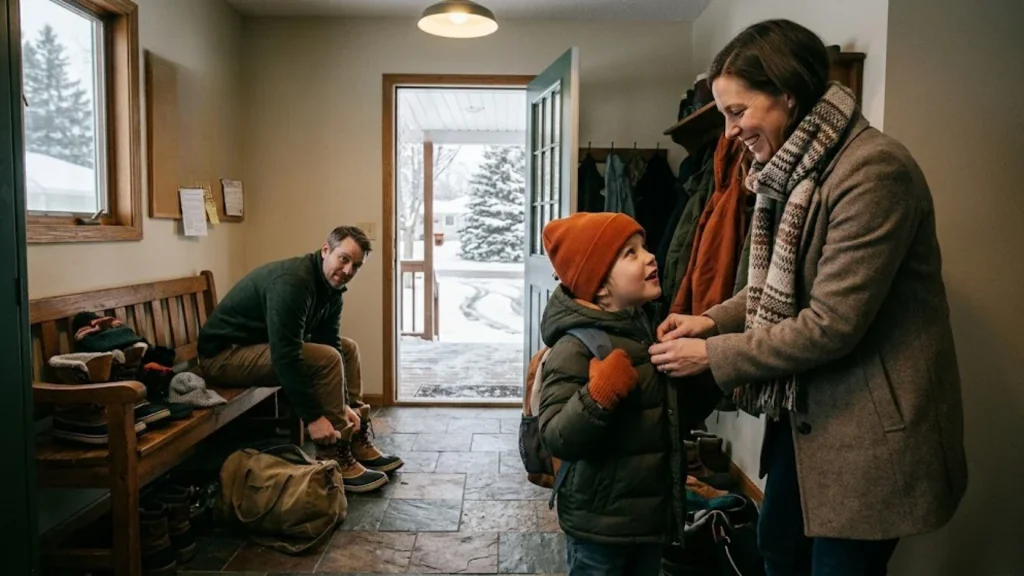
Winter pushes the sensory load indoors and into the car. Families in Oakdale and across Minnesota deal with long drives, early darkness and warm, closed-up houses where everyone ends up in one room. These sensory friendly holiday tips for kids matter most here:
- Check roads before you leave. The MnDOT Minnesota 511 map shows winter road conditions, so a delay does not turn into a stressful drive for everyone in the car.
- Build in movement. A stop to stretch on the way, or a hallway obstacle course at the host’s home, stands in for the outdoor play your child would get in summer.
- Cool the quiet spot. Heated rooms get stuffy. Ask the host to open a window in the retreat space, or take a few minutes outside when the weather allows.
- Watch the scents. Candles, pine, perfume and cooking all build up when windows stay shut. Ask the host to skip scented candles in or near the quiet spot.
- Use a visual timer. It is dark by late afternoon, so a timer or picture schedule helps a child follow how much of the day is left.
How Do You Explain Your Child’s Needs to Relatives?
Keep it short and specific, and talk about what helps rather than what is wrong. Send a message a few days ahead, not in the doorway.
My child gets overwhelmed when it is loud and crowded. A wave or fist bump works better than a hug. If they go to the quiet spot, that is how they reset, and they will be back
Ask for one or two things only, such as lower music or no pressure to hug or eat. Pick one adult who will back you up, and have the conversation away from your child.
If a relative pushes back, you do not owe a long defense. Forced hugs and “just one bite” rarely help, and they teach a child that their signals do not count.
Want to know who you would work with? Meet our team.
When Should You Ask an Occupational Therapist for More Support?
Consider talking with an occupational therapist if overload happens often, outside the holidays, or in ways that limit daily life. One hard December does not point to a problem. A pattern might.
Reasons to ask for guidance:
- Everyday sounds, textures, lights or crowds regularly cause strong distress
- Your child avoids places or activities that peers enjoy
- Recovery takes hours or days
- Sleep or eating is disrupted after busy events
- Your family has stopped going places to avoid meltdowns
Can occupational therapy help with sensory needs?
Yes, it can. An occupational therapist looks at how your child takes in and responds to sensory information, then builds strategies around everyday routines. At CSLL, sessions are hands-on and playful, and families get practical strategies to use at home and school.
A first step is a conversation about what you are seeing, then an occupational therapy evaluation if it makes sense. Our FAQ page answers common questions about starting therapy, and our insurance and payment page explains coverage.
Where Can You Get a Printable One-Page Holiday Plan?
This one-page plan puts the steps above on a single sheet you can print and tape to the fridge. Fill in your child’s greeting choices, the signal you agreed on, the quiet spot, and the leave-by time.
Want a longer runway? Understood also offers a six-week sensory-friendly holiday checklist.
The Bottom Line: A Calm Holiday Starts With a Plan
Holidays go better when a child knows what will happen, has a place to reset, and has a plan for leaving.
Start with the preview, the quiet spot, and a simple signal, then add the rest as your family needs it.
Expect overload to show up late, and keep the day after the gathering light.
Keep the sensory friendly holiday tips for kids that work and drop the ones that do not.
If the same struggle returns every season, an occupational therapist can help you understand why.
How Can CSLL Help With Sensory Needs?
At Center for Speech, Language, and Learning, licensed occupational therapists in Oakdale work with children on sensory needs, fine motor skills, self-care and coordination, and your child sees a consistent therapist.
- Who: licensed occupational therapists, alongside speech-language pathologists and an EIDBI team. Meet our team to see who you would work with.
- How we work: hands-on, playful sessions that build skills through movement and real-life tasks, with practical strategies for home and school.
- One roof: occupational therapy in Oakdale, speech therapy and EIDBI, all in one clinic. See all services.
CSLL is at 434 Hayward Avenue N. in Oakdale (get directions), and we see families by appointment Monday through Friday. Please confirm current availability, insurance details and whether an evaluation is appropriate directly with the clinic.
Ready to Make the Holidays Easier for Your Child? Contact CSLL Today
If the holidays keep overwhelming your child, you do not have to wait for it to ease on its own. At Center for Speech, Language, and Learning (CSLL), our licensed occupational therapists work with families in Oakdale and the East Metro to understand how your child handles sensory input and recommend the right next step. If these sensory friendly holiday tips for kids helped, we can build on them together. Call or email us to ask your questions and talk through what you have noticed.
📍 Location: 434 Hayward Ave N, Oakdale, MN 55128
📞 Contact Number: 651-739-2300
✉️ Mail: office@csllinc.com