
Speech Milestones by Age: What Parents Should Know
Every child develops communication skills at their own pace, and understanding speech milestones by age can help parents recognize progress and know when to seek guidance. Some children begin using words early, while others take more time to build their vocabulary and form sentences.
Understanding speech and language milestones by age can help you recognize emerging skills, support your child’s communication at home, and identify when it may be helpful to seek professional guidance.
Speech and language development involves much more than saying words clearly. Children also learn to understand what others say, follow directions, use gestures, combine words, participate in conversations, and communicate their thoughts and feelings.
This guide explains common communication milestones from infancy through age five, including what parents may notice at different stages, practical ways to encourage development, and signs that may warrant a professional evaluation.
An important note: Developmental milestones are general guidelines, not a diagnosis or a strict deadline. The American Speech-Language-Hearing Association (ASHA) and the Centers for Disease Control and Prevention (CDC) provide milestone resources to help families monitor development and decide when to discuss concerns with a professional.
Speech vs. Language: What Is the Difference?
Although people often use the terms speech and language interchangeably, they describe different communication skills.
Speech refers to how a child produces sounds and words. It includes articulation, pronunciation, and the coordination needed to speak clearly.
Language refers to understanding and communicating meaning. It includes vocabulary, grammar, combining words into sentences, understanding directions, and using language in social situations.
Language has two important parts:
Receptive language: What a child understands, such as words, questions, and instructions.
Expressive language: What a child communicates through words, sentences, gestures, or other communication methods.
For example, a toddler might understand “Bring me your shoes” but use only a few spoken words. Another child might speak frequently but struggle to follow simple directions. These are different communication profiles, and both may deserve attention if concerns persist.
A speech-language pathologist (SLP) can assess a child’s understanding, expression, speech sounds, and everyday communication to identify strengths and areas where support may help.
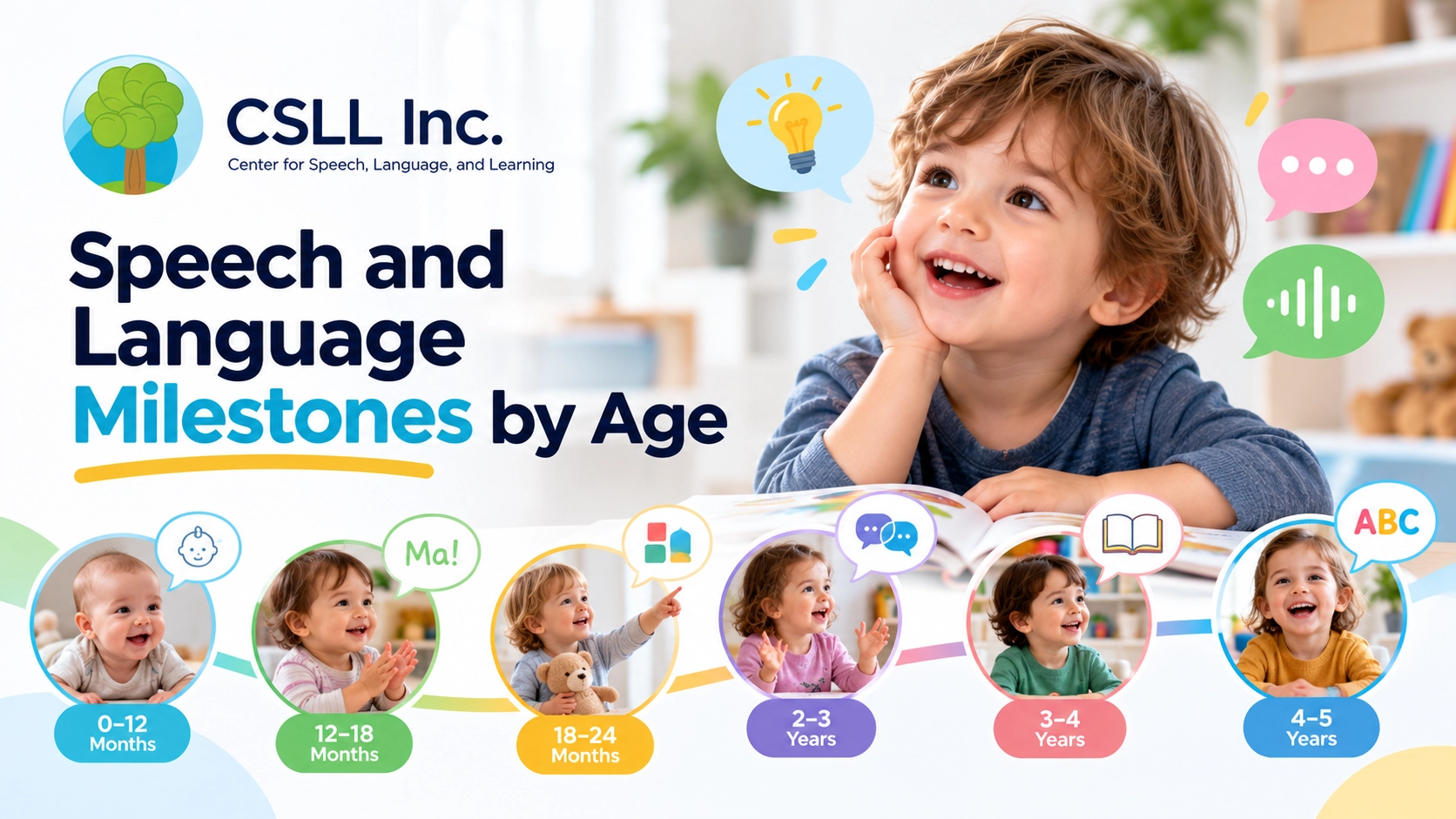
Speech and Language Milestones by Age
The milestones below offer a general overview of communication development. Children may develop individual skills at different times, and not every child will demonstrate every skill at the beginning of an age range.
Birth to 12 Months: Early Communication Begins
During the first year, babies build the foundations for communication through listening, eye contact, facial expressions, vocalizations, and gestures.
Skills parents may notice include:
- Responding to familiar voices and sounds.
- Smiling or making sounds during social interaction.
- Babbling with repeated sounds such as “bababa” or “mamama.”
- Turning toward sounds or familiar voices.
- Using gestures such as reaching, pointing, or waving as the first year progresses.
- Showing interest in interactive games such as peekaboo.
Babbling is an important part of early speech development, even before a baby says recognizable words. Gestures, facial expressions, and shared attention also help babies communicate their needs and interests.
How parents can help: Talk to your baby throughout everyday routines. Describe what you are doing during feeding, dressing, bathing, and playtime. Respond to your baby’s sounds as if you are having a conversation, leaving pauses for another vocalization. Read picture books, sing songs, and play simple face-to-face games.
When to seek guidance: If your baby does not seem to respond to sounds, loses communication skills, or you have concerns about hearing or interaction, discuss them with your pediatrician.
12 to 18 Months: First Words and Meaningful Gestures
During this stage, many children begin using words intentionally and communicating more clearly through gestures and sounds.
Skills parents may notice include:
- Using gestures to request something or draw attention to an object.
- Understanding familiar words and simple directions.
- Recognizing names of familiar people, objects, and everyday activities.
- Beginning to use meaningful spoken words.
- Pointing to show interest or request help.
- Trying to imitate words, sounds, and actions.
A child’s communication is not measured by spoken words alone. Understanding language, pointing, showing objects, and responding during interaction are also valuable parts of development.
How parents can help: Follow your child’s interests and name the objects they look at or reach for. If your child points to a cup, you might say, “Cup! You want your cup.” Keep phrases simple, repeat useful words naturally, and give your child time to respond instead of immediately anticipating every need.
When to seek guidance: If your child is not developing expected communication skills, seems unable to understand familiar language, or has lost skills they previously used, seek guidance rather than waiting for a particular birthday.
18 to 24 Months: Vocabulary Starts Growing
Between 18 and 24 months, many children begin using words more frequently and start combining words to communicate simple ideas. Parents often search for 2 year old speech milestones because this stage can bring noticeable changes in vocabulary and early sentence development.
Skills parents may notice include:
- Using an expanding range of meaningful words.
- Understanding more everyday words and simple instructions.
- Pointing to or identifying familiar people, objects, or body parts when asked.
- Beginning to combine two words, such as “more milk,” “mommy up,” or “go outside.”
- Using words, gestures, and sounds to request, comment, or protest.
- Participating in simple back-and-forth interactions.
The number of words a child uses is only one part of the picture. How a child understands language, communicates needs, uses gestures, and combines words also matters.
How parents can help: Build on what your child says. If your child says “ball,” you might respond, “Big ball!” or “Throw the ball.” Read short books together, label pictures, sing familiar songs, and offer simple choices such as “Apple or banana?” Avoid turning everyday conversations into constant testing. Children often learn best through warm, responsive interactions that make communication meaningful.
When to seek guidance: If your child is not using words as expected, is not beginning to combine words around this stage, or seems to have difficulty understanding familiar language, consider discussing a speech-language evaluation with your pediatrician or an SLP.
2 to 3 Years: Combining Words and Expressing Ideas
Between ages two and three, children often make progress in vocabulary, sentence development, understanding, and social communication. This is an important period for 3 year old language development, although communication abilities can vary considerably from one child to another.
Skills parents may notice include:
- Using two- or three-word combinations and gradually producing longer sentences.
- Asking for things and commenting on what is happening.
- Following simple directions and understanding familiar questions.
- Naming familiar objects and talking about everyday activities.
- Beginning to participate in short conversations.
- Showing growing interest in pretend play and interacting with other children.
Speech clarity is also developing during these years. A child may still mispronounce some sounds, and unfamiliar listeners may not understand every word. However, parents should pay attention to whether their child’s communication is progressing and whether difficulties are interfering with everyday interactions.
How parents can help: Talk about what your child is doing during play, meals, and outings. Expand short phrases into slightly longer sentences. For example, if your child says “dog running,” you could respond, “Yes, the dog is running fast!” Ask simple questions, allow time for answers, and take turns during play. Picture books are useful for discussing characters, actions, and what might happen next.
When to seek guidance: If your child rarely combines words, struggles to understand simple directions, has difficulty communicating basic needs, or appears increasingly frustrated when trying to communicate, an evaluation may help clarify what support is appropriate.
3 to 4 Years: Longer Sentences and Conversations
During the preschool years, many children begin using longer sentences and sharing more information about their experiences.
Skills parents may notice include:
- Speaking in sentences that become longer and more detailed.
- Asking and answering simple questions.
- Talking about familiar activities, people, and events.
- Participating in short conversations with adults and other children.
- Beginning to tell simple stories or describe what happened.
- Understanding more concepts and directions used in daily routines.
Parents may also notice progress in grammar, vocabulary, and speech clarity. Children are still learning the rules of language, so occasional grammatical errors and some sound-production difficulties can occur.
How parents can help: Encourage your child to describe pictures, talk about a recent outing, or explain what happened during play. Read stories and ask open-ended questions such as “What do you think happens next?” Give your child time to finish speaking. Rather than correcting every mistake, respond naturally using the intended wording. For example, if your child says, “He goed home,” you might say, “Yes, he went home.”
When to seek guidance: If your child has difficulty expressing basic ideas, understanding questions, participating in conversation, or being understood in everyday situations, consider seeking professional guidance.
4 to 5 Years: More Detailed Language and Storytelling
As children approach kindergarten, language becomes increasingly important for learning, friendships, classroom participation, and explaining their thoughts.
Skills parents may notice include:
- Using longer, more complex sentences.
- Describing events and sharing details about their day.
- Telling or retelling simple stories.
- Understanding and using a wider range of vocabulary.
- Following directions and participating in conversations.
- Becoming easier to understand during everyday communication.
Children also develop early literacy-related skills, such as enjoying rhymes, noticing sounds in words, and becoming familiar with books and print. These skills develop over time and vary with each child’s experiences and opportunities.
How parents can help: Read together regularly and discuss what is happening in the story. Invite your child to explain how they built something, describe a drawing, or tell you about a favorite activity. Play rhyming games, sing songs, and encourage conversations that involve taking turns and listening.
When to seek guidance: If your child has persistent difficulty telling a story, understanding directions, expressing ideas, or being understood by others, an SLP can help determine whether further assessment or support would be beneficial.
The CDC’s age-based milestone resources and ASHA’s communication checklists provide additional examples of skills children commonly develop during these stages.
When Should You Be Concerned About Your Child’s Speech?
Children do not all develop at the same speed. However, it is important to recognize when a child may benefit from additional support.
Consider speaking with your pediatrician or a speech-language pathologist if your child:
- Is not developing communication skills expected for their age.
- Has difficulty understanding familiar words, questions, or simple directions.
- Uses fewer words or shorter phrases than expected for their developmental stage.
- Has difficulty communicating basic needs, thoughts, or feelings.
- Is frequently difficult for familiar or unfamiliar listeners to understand.
- Shows limited progress in communication over time.
- Becomes frustrated frequently because others cannot understand them.
- Has difficulty participating in age-appropriate conversations or social interactions.
- Loses words, gestures, or other communication skills they previously used.
A loss of previously acquired skills deserves prompt discussion with your child’s healthcare provider. Do not wait for your child to reach the next milestone age before raising a concern.
An evaluation does not automatically mean your child needs ongoing therapy. It can help identify what your child already does well, whether further assessment is appropriate, and what steps may be useful.
The CDC recommends discussing developmental concerns with a healthcare professional and not waiting when a child is missing milestones or loses skills. Milestone checklists are helpful monitoring tools, but they are not substitutes for validated developmental screening or professional assessment.
Does Understanding Language Matter as Much as Speaking?
Yes. Communication includes both what a child says and what they understand.
Some children may use a number of words but have difficulty following directions or understanding questions. Others may understand familiar language well but use fewer spoken words than expected.
These differences are important because receptive and expressive language are related but distinct skills. An assessment can examine both, along with gestures, social communication, speech sounds, and the child’s communication in everyday situations.
Parents should also share concerns about hearing. Hearing difficulties can affect a child’s access to spoken language, and a healthcare professional may recommend a hearing assessment as part of the next steps.
What If My Child Is Bilingual?
Growing up with two or more languages does not, by itself, cause a speech or language disorder.
Children who hear and use multiple languages may distribute their vocabulary across those languages. For that reason, looking only at the words a child uses in English may not give a complete picture of their communication skills.
When discussing concerns with a professional, share:
- The languages your child hears and uses.
- Who speaks each language with your child.
- The words, phrases, and gestures your child uses in each language.
- How your child understands directions and communicates at home, childcare, or school.
A qualified speech-language pathologist should consider the child’s language background when evaluating communication. ASHA notes that its English communication milestone checklists are based on American English-speaking children, so milestones should not be applied mechanically to children who use other languages.
7 Practical Ways to Support Speech and Language Development at Home
- Talk during everyday routines. Describe what you are doing while getting dressed, preparing a meal, shopping, or playing.
- Read together every day. Name pictures, talk about characters, and let your child turn pages or choose a book. You do not have to read every word exactly as written.
- Follow your child’s interests. If your child is focused on a toy car, use that interest to talk about its color, movement, size, and where it is going.
- Expand your child’s words. If your child says “truck,” you might respond, “A big blue truck!” This models slightly more advanced language without demanding repetition.
- Give your child time to respond. Pause after asking a question or making a comment. Children may need extra time to understand what they heard and formulate a response.
- Use songs, rhymes, and pretend play. Familiar songs, simple games, and imaginative play encourage listening, vocabulary, turn-taking, and interaction.
- Make communication enjoyable. Respond to your child’s attempts to communicate, including gestures and other meaningful signals. Focus on connecting with your child rather than correcting every mistake.
If you have concerns despite trying these strategies, do not feel that you must solve the issue at home before asking for help. Professional guidance can complement the communication opportunities you already provide.
How Can a Speech-Language Pathologist Help?
A speech-language pathologist evaluates how a child understands and uses communication and identifies areas where additional support may be beneficial.
Depending on the child’s needs, an evaluation may consider:
- Receptive and expressive language.
- Vocabulary and sentence development.
- Speech sound production and clarity.
- Social communication and conversational skills.
- Communication during play and everyday activities.
- Relevant developmental and hearing history.
The SLP uses the findings to discuss the child’s strengths, areas of concern, and possible next steps with the family. If therapy is recommended, goals should be tailored to the child rather than based on age alone.
At CSLL Inc., licensed speech-language pathologists support children with language development, articulation, fluency, and social communication. The clinic’s approach includes individualized goals, play-based sessions, and practical strategies parents can use between visits.
Frequently Asked Questions
What are the most important speech milestones by age?
Important milestones include early babbling and gestures during infancy, meaningful words during toddlerhood, combining words around the second year, and increasingly detailed sentences and conversations during the preschool years. Understanding language is also important. Review age-specific resources from ASHA and the CDC for more detail.
What are typical 2 year old speech milestones?
Around age two, many children begin combining two words, such as “more milk” or “go outside,” while their vocabulary and understanding continue to grow. If your child is not combining words or you have concerns about their understanding or communication, discuss those concerns with a healthcare professional or SLP.
What should I expect from 3 year old language development?
Between ages three and four, children often begin using longer sentences, answering simple questions, talking about familiar experiences, and participating in short conversations. Skills vary, so consider your child’s overall communication rather than judging development by one skill alone.
Should I wait and see if my child catches up?
Some children develop particular skills later than others, but it is not possible to determine the reason from age alone. If your child is missing milestones, making limited progress, or losing skills, speak with your pediatrician and ask whether a speech-language evaluation or developmental screening is appropriate.
Can a child understand everything but still have a speech delay?
Yes. Understanding language and expressing it are different skills. A child may understand familiar instructions but have difficulty using words or sentences. An evaluation can help clarify the child’s communication profile and whether support is needed.
Does speech therapy help toddlers?
Speech-language therapy may help toddlers who have difficulty developing communication skills. The appropriate approach depends on the individual child’s needs, developmental profile, and evaluation findings. An SLP can explain suitable options and ways to encourage communication at home.
Help Your Child Build Communication Skills With Confidence
Understanding speech and language milestones can help you recognize your child’s progress and know when to ask questions. You do not need to wait until a concern becomes overwhelming to seek guidance.
If you have questions about your child’s speech, language, or communication development, CSLL Inc. can help you explore the next steps.
Schedule a free consultation with CSLL Inc. to discuss your concerns and learn more about pediatric speech-language services in Oakdale, Minnesota, and the surrounding Twin Cities area.
Every child’s communication journey is different. The right guidance can help your family understand your child’s needs and support their progress with confidence.
Helpful Resources for Parents
- ASHA: Developmental Milestones — Birth to 5 Years: https://www.asha.org/public/speech/development/chart/
- CDC: Developmental Milestones: https://www.cdc.gov/act-early/milestones/
- CSLL Inc.: Pediatric Speech Therapy: https://csllinc.com/speech-therapy/
- CSLL Inc.: Get Started: https://csllinc.com/new-patient/
Disclaimer: This article is for general educational purposes only. It is not a substitute for individualized medical advice, developmental screening, or a speech-language evaluation.