

Signs Your Child Needs Speech Therapy: A Parent’s Guide
A grandparent asks why your two-year-old is not talking much yet. A teacher mentions that other children are easier to understand. Or you notice your child becoming frustrated when trying to explain something. These moments can leave parents wondering whether a child’s communication is developing as expected.
Not every difference means a child has a speech or language disorder. Children develop at different rates, and one missed milestone cannot diagnose a problem. However, if your child has difficulty understanding language, expressing ideas, being understood, or participating in everyday conversations, it is reasonable to discuss your concerns with a pediatrician or a licensed speech-language pathologist (SLP). You do not need to wait until a child reaches a particular age or until the concern becomes severe.
Below are common signs to notice, age-related communication milestones, and practical next steps. This guide is for general information and is not a substitute for an individual evaluation.
1. Your Child Is Difficult to Understand
Young children are still learning how to coordinate the lips, tongue, and airflow needed to produce speech sounds. Some mispronunciations are expected as speech develops, and certain sounds may take longer to master. The concern is less about one imperfect sound and more about the overall pattern and how well your child can communicate.
Consider discussing an evaluation if family members, caregivers, teachers, or other children often struggle to understand your child; if your child becomes upset because people cannot understand them; or if unclear speech is making it difficult to participate in play, school, or family conversations. An SLP can assess speech sound patterns and determine whether support would be helpful.
2. Your Toddler Uses Few Words or Is Not Combining Words
Children gradually build vocabulary and begin combining words to express more specific ideas. A toddler who relies mainly on pointing, pulling an adult’s hand, or using a small number of words may be communicating in ways that deserve a closer look—especially if their communication is not progressing over time.
For example, a child may point to a cup rather than say or attempt “want water,” or may become frustrated because they cannot tell you what they need. These behaviors do not prove a disorder, but they are useful observations to share with a professional. If your child has very few words, is not beginning to combine words around age two, or you have concerns at any age, ask about an evaluation rather than relying only on advice to wait.
3. Your Child Has Trouble Understanding What Others Say
Communication involves both understanding language and using language. Receptive language refers to what a child understands; expressive language refers to how a child communicates thoughts, needs, and ideas. A child may have difficulty in one area or both.
A child with possible receptive-language difficulties may struggle to follow familiar directions, answer questions, or understand words used in everyday routines. They may watch other children and copy what they do rather than respond to spoken instructions. Hearing differences can also affect how a child responds to language, so a professional may recommend a hearing check as part of the next steps.
4. Your Child Struggles to Build Sentences or Explain Ideas
As children grow, they generally move from single words to short phrases and then to longer sentences. Language concerns may show up as a vocabulary that seems limited for the child’s age, difficulty combining words, trouble answering who/what/where questions, or difficulty explaining what happened during the day.
A preschooler may understand a story but find it hard to retell it, or may use very short phrases when classmates are beginning to share longer ideas. These patterns can affect classroom participation, friendships, and the ability to explain needs. An SLP can look at understanding, vocabulary, grammar, sentence structure, and storytelling in context.
5. Your Child Repeats or Gets Stuck on Sounds and Words
Some repetitions, pauses, and sentence restarts are common as young children learn to express increasingly complex ideas. Stuttering may involve repeating parts of words (such as “b-b-ball”), stretching a sound, or getting blocked while trying to speak. Some children also show physical tension, frustration, or avoidance.
Consider contacting an SLP if your child appears distressed when speaking, avoids certain words or situations, shows tension, or the pattern is increasing or persisting. A family history of stuttering is also worth mentioning. Do not interrupt, rush, or pressure your child to “slow down” or start again; listen patiently and focus on what they are saying.
6. Conversation and Social Communication Are Difficult
Social communication includes the back-and-forth skills people use to connect with others. Depending on age and context, a child may find turn-taking, staying on topic, answering a conversational partner, explaining an idea clearly, or adapting a message to the listener challenging.
For example, a child may talk at length about a favorite topic but find it hard to respond to what another child says, or may struggle to join a group conversation. These observations should be considered alongside the child’s overall development and communication style. An SLP can help assess social communication and discuss appropriate support when needed.
7. Your Child Loses Communication Skills They Previously Had
A child who stops using words, gestures, or other communication skills they previously had should be assessed promptly. A loss of previously acquired skills is different from a temporary slowdown in progress. Contact your child’s pediatrician promptly to discuss what you have noticed and ask about appropriate evaluation or referrals.
Communication Milestones: What Parents Can Watch For
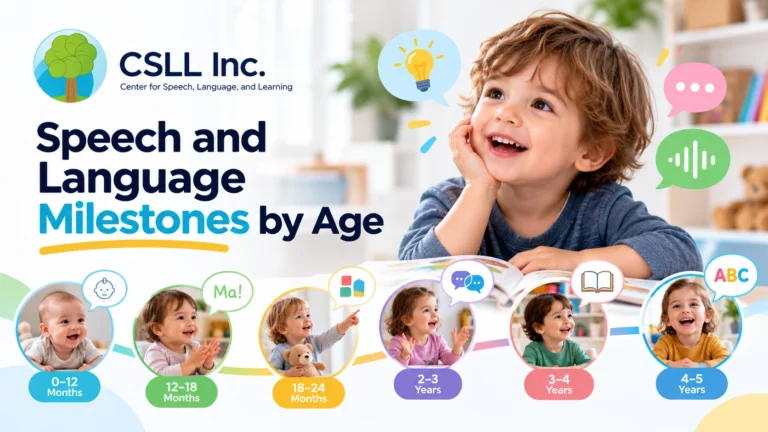
Milestones are broad guideposts, not a diagnosis or a guarantee that every child will develop in exactly the same way. The CDC describes milestones as skills that most children (at least 75%) can do by a given age. If a child is not meeting milestones, loses skills, or a caregiver has concerns, discuss them with the child’s healthcare provider. For age-specific examples, see the CDC milestones for 2-year-olds, 3-year-olds, and 4-year-olds.
Around 1 year: Many children use a special name such as “mama” or “dada,” respond to familiar words, and communicate through gestures and sounds.
By 2 years: Many children point to things in a book when asked, point to body parts, use a range of gestures, and say at least two words together, such as “more milk.”
By 3 years: Many children take part in at least two back-and-forth conversational exchanges, ask simple who/what/where/why questions, and are understood by others most of the time.
By 4 years: Many children use sentences of four or more words, say some words from songs or stories, talk about something that happened during the day, and answer simple questions.
Milestones should be interpreted in context. Do not use this short list as a screening tool, and do not wait for a milestone age if you are already concerned. Your pediatrician or an SLP can help determine whether further assessment is appropriate.
Does Being Bilingual Cause a Speech or Language Delay?
No. Learning more than one language does not cause a speech or language disorder. Children who hear and use multiple languages may distribute their vocabulary across those languages, so looking at only one language can give an incomplete picture. During an evaluation, families should share which languages the child hears and uses, with whom, and in what settings. A qualified clinician should consider the child’s full language background when interpreting communication skills.
What to Write Down Before an Evaluation
You do not need to diagnose the issue yourself. A few concrete examples can help the clinician understand your concern. Consider noting:
- When you first noticed the concern and whether it has changed.
- Examples of words, sounds, directions, or conversations that are difficult for your child.
- Whether the concern also appears at childcare, preschool, or school.
- The languages your child hears and uses, and who speaks each language with them.
- Any family history of speech, language, hearing, or stuttering concerns.
- Whether your child has had a hearing check and whether any communication skills have been lost.
What Happens During a Speech-Language Evaluation?
The process depends on the child’s age and the concerns being assessed. An SLP may ask about developmental history, health, hearing, languages used at home, and how the child communicates in everyday situations. The clinician may use age-appropriate assessment activities, observe play or conversation, and consider information from caregivers or teachers when appropriate.
After the assessment, the SLP should explain the findings in understandable language and discuss possible next steps. These may include therapy, additional assessment, monitoring, or reassurance that the child’s current skills are within an expected range. Ask questions if anything is unclear, and share any concerns that matter to your family.
How You Can Support Communication at Home
Everyday interactions can create opportunities for communication. These strategies are supportive, but they do not replace an evaluation when concerns are present:
- Follow your child’s interests and talk about what you are looking at or doing together.
- Read together and pause to talk about pictures, characters, and what might happen next.
- Give your child time to respond instead of immediately finishing their sentence.
- Respond to gestures, sounds, and words as meaningful attempts to communicate, and model a slightly longer phrase when it fits naturally.
- Use the language or languages in which your family communicates most comfortably.
- Avoid repeatedly correcting speech sounds or pressuring your child to perform. Model words naturally and keep interactions positive.
How CSLL Can Help
Center for Speech, Language, and Learning, Inc. (CSLL) provides pediatric speech-language pathology services in Oakdale, Minnesota. The clinic’s speech therapy services address areas such as speech sounds, language development, fluency, and social communication. CSLL describes its approach as individualized and play-based, with parent involvement and practical strategies families can use between sessions.
If you are concerned about your child’s communication, you can learn more about CSLL’s speech therapy services or contact the clinic to ask about next steps. CSLL is located at 434 Hayward Ave N, Oakdale, MN 55128, and can be reached at (651) 739-2300. Confirm current availability, consultation terms, insurance details, and whether an evaluation is appropriate directly with the clinic.
Frequently Asked Questions
What are early signs that a child may need speech therapy?
Possible signs include limited use of words or gestures, difficulty combining words, trouble understanding familiar directions, speech that is difficult for others to understand, persistent or distressing stuttering, and difficulty participating in back-and-forth communication. These signs are reasons to discuss concerns, not a diagnosis.
Should I worry if my toddler is not talking?
If your toddler has very few words, is not combining words around age two, has difficulty understanding language, or you are concerned for any reason, discuss it with your pediatrician or an SLP. You do not need to wait until the concern becomes more obvious.
Can a child understand language but still have trouble speaking?
Yes. Receptive language (understanding) and expressive language (using words to communicate) are related but distinct skills. A child may have difficulty with one or both.
Does being bilingual cause speech delay?
No. Bilingualism does not cause a speech or language disorder. An evaluation should consider the child’s experiences and skills across the languages they use.
What happens at a first speech-language evaluation?
The SLP typically discusses the child’s developmental and communication history and uses age-appropriate assessment and observation. The clinician then explains the findings and possible next steps.
Should I wait and see if my child catches up?
Development varies, but you do not need to wait if you are concerned. A pediatrician or SLP can help decide whether an evaluation, monitoring, or another next step is appropriate.
The Bottom Line
Noticing one of these signs does not mean your child has a disorder, and it is not a reason to panic. It is a reason to pay attention and ask questions when a pattern concerns you. If your child’s speech, understanding, or everyday communication is affecting family life, friendships, or learning, contact your pediatrician or a licensed speech-language pathologist to discuss an evaluation. Early questions can help you understand your child’s needs and make an informed plan.