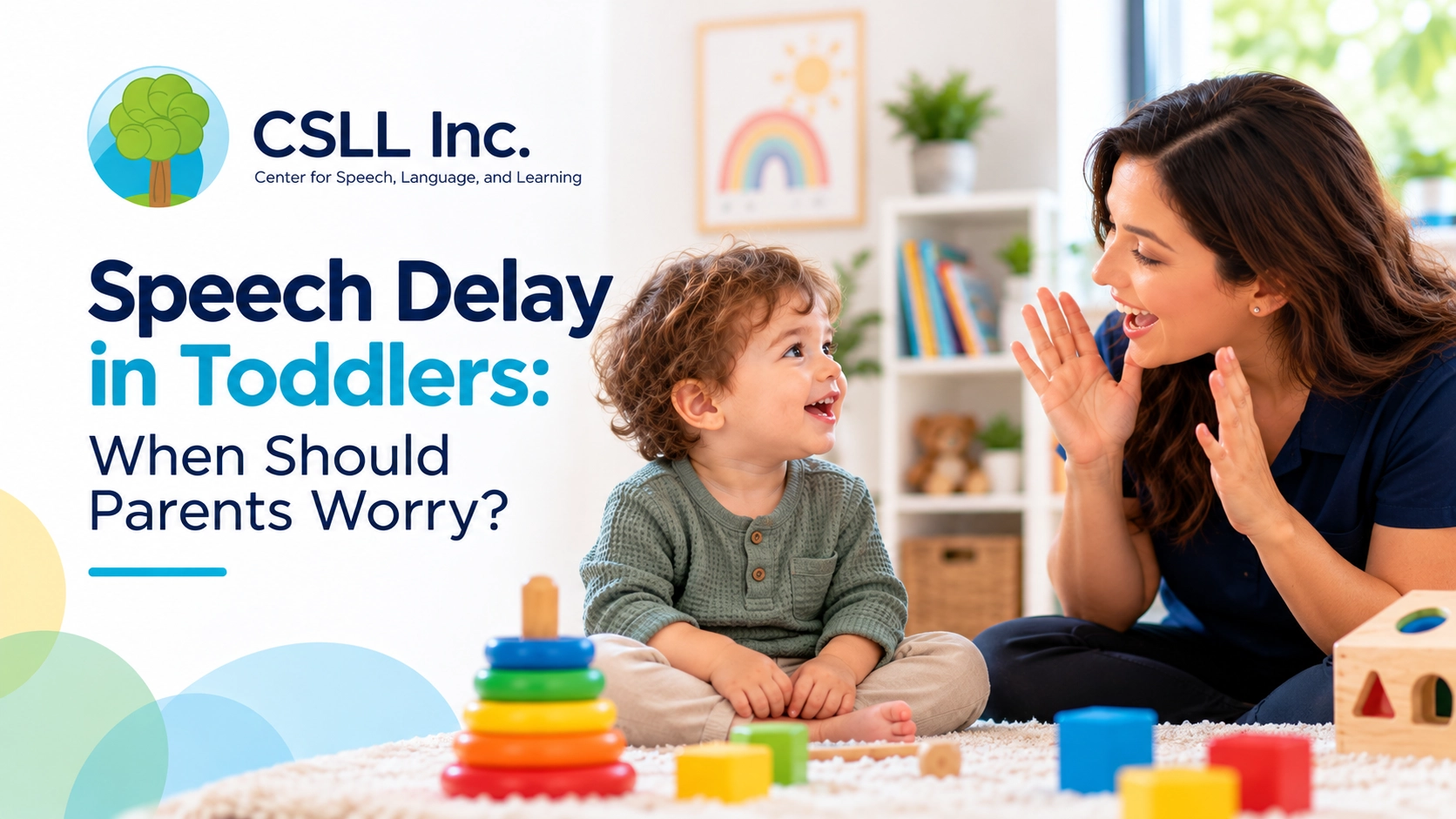

Speech Delay in Toddlers: When Should Parents Worry?
You ask your toddler a question, and they point instead of answering. Other children at daycare seem to be using short sentences, while your child relies on a few familiar words, sounds, or gestures. You may find yourself wondering: Is my toddler simply a late talker, or could this be a speech delay?
It is understandable to have questions. Children develop communication skills at different rates, and a single milestone does not tell the whole story. Still, persistent difficulty understanding language, using words, or combining words is worth discussing with a professional. You do not need to wait for your child to “grow out of it” before asking for guidance.
This guide explains common late-talker signs, what communication may look like around age two, what can contribute to a delay, and how parents can take practical next steps. It is general information, not a diagnosis of your child.
What Does Speech Delay in Toddlers Mean?
People often use “speech delay” as a broad term, but speech and language are not exactly the same. Speech is how we produce sounds and words. Language is how we understand and share meaning, including through words, sentences, gestures, and other forms of communication.
A toddler may have difficulty with speech sounds, expressive language (using words to communicate), receptive language (understanding what others say), or more than one area. For example, one child may understand familiar directions but use very few words. Another may speak often but struggle to understand questions or follow directions. An evaluation should look at the child’s full communication profile—not just the number of words they say.
A “late talker” is a term sometimes used for a young child whose spoken-language development is slower than expected, without another diagnosed developmental condition. Some late talkers catch up, while others continue to need support. There is no reliable way for a parent to predict a child’s outcome from one sign alone, which is why monitoring and assessment can be helpful.
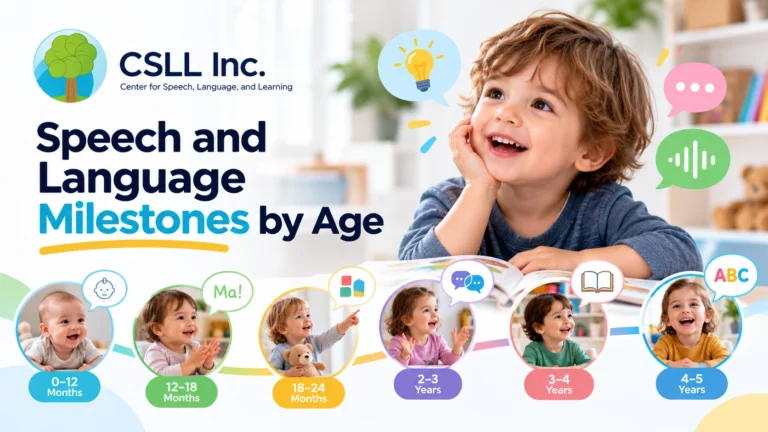
Speech and Language Milestones to Know
Milestones are useful guideposts, not pass-or-fail tests. The Centers for Disease Control and Prevention (CDC) explains that its milestone checklists describe skills that most children—at least 75%—can do by a given age. They do not replace developmental screening or a professional evaluation.
Around 18 months, many children try to say three or more words besides names such as “mama” or “dada,” and can follow a one-step direction without a gesture.
By 2 years, many children point to things in a book when asked, point to at least two body parts when asked, use more gestures, and say at least two words together—for example, “more milk.”
By 30 months, many children say around 50 words, combine two or more words with an action word (such as “doggie run”), name things in a book when asked, and follow a two-step instruction.
For age-specific examples, parents can review the CDC’s 18-month milestones, 2-year milestones, and 30-month milestones. A milestone list cannot diagnose a delay. If your child is not meeting milestones, has lost skills, or you are concerned, talk with your child’s healthcare provider.
Speech Delay Age 2: When Should Parents Take Notice?
Age two is a common point when parents notice a gap between their child’s communication and that of other toddlers. One widely used clinical indicator of late language emergence is an expressive vocabulary of fewer than 50 words and no two-word combinations by 24 months. This is a screening clue—not a diagnosis and not the only factor a clinician considers.
It is worth seeking advice if your two-year-old uses very few words, is not beginning to combine words, has difficulty understanding familiar language, rarely uses gestures to communicate, or seems increasingly frustrated when trying to express needs. A child’s ability to understand language, use gestures, play, interact, and learn new words also matters.
Do not rely on a strict word count alone. Some children use gestures effectively but have limited spoken words; others may repeat familiar lines or name letters and numbers but struggle to use words to request, answer, or share ideas. Share these observations with your pediatrician or speech-language pathologist (SLP) so they can consider the whole picture.
Common Late Talker Signs Parents May Notice
Consider discussing an evaluation if you notice one or more of these patterns over time:
- Your toddler uses fewer words than expected for their age or is not adding new words over time.
- Your child is not combining words by around age two.
- Your toddler has difficulty following familiar directions or understanding everyday words.
- Your child relies heavily on pointing, pulling an adult, or crying because it is difficult to communicate needs.
- Your toddler has trouble using gestures, such as pointing to show interest or waving goodbye.
- Your child seems to understand or respond to sounds inconsistently; hearing should be considered as part of the evaluation process.
- Your child becomes upset frequently because others do not understand what they want to say.
- Your child loses words, gestures, or communication skills they previously used.
These signs do not automatically mean a child has a language disorder. They are reasons to ask questions and get individualized guidance. A loss of previously acquired communication skills should be discussed promptly with your child’s pediatrician.
Why Might a Toddler Be Talking Late?
There is no single cause of late talking. Children differ in their developmental paths, and language delays can be associated with different factors. These may include hearing difficulties, challenges with understanding or using language, broader developmental differences, or a combination of influences. In some cases, no clear cause is identified at first.
Hearing deserves particular attention because a child may respond to some sounds but still have difficulty hearing speech clearly. A pediatrician or SLP may recommend a hearing assessment as part of the next steps. A professional can also consider the child’s play, gestures, social communication, understanding, and development in other areas.
Parents should not try to diagnose the cause at home. Instead, note what you see and discuss it with a qualified professional. If other developmental concerns are present, mention them rather than focusing only on spoken words.
Does Growing Up Bilingual Cause Speech Delay?
No. Learning two or more languages does not cause a speech or language disorder. A child who hears multiple languages may use words across those languages, so counting words in only one language can give an incomplete picture. A careful evaluation should consider all the languages the child hears and uses, as well as who speaks each language and in which settings.
If your family uses more than one language, keep speaking with your child in the languages you know best. Share your child’s language experiences with the clinician so their skills can be considered fairly and in context.
What Should You Do If Your Toddler Is Not Talking?
Start by raising your concern with your child’s pediatrician and asking whether a developmental screening, hearing evaluation, or speech-language assessment is appropriate. You can also contact a licensed SLP to ask about an evaluation. You do not have to wait for a child to start preschool or for a delay to become severe before seeking advice.
During an assessment, the clinician may ask about your child’s health and developmental history, the languages spoken at home, how your child communicates during play and routines, and what they understand as well as what they say. The assessment may include play-based observation and age-appropriate activities. A hearing check may also be recommended.
After the evaluation, the clinician should explain the findings and discuss next steps. Depending on the child’s needs, these may include parent-guided strategies, monitoring progress, further assessment, or speech-language therapy. An evaluation does not automatically mean a child will need ongoing therapy; it helps families make an informed decision.
How Parents Can Encourage Language at Home
Everyday routines offer many chances to support communication. These ideas can help build interaction, but they are not a substitute for professional advice when concerns persist.
- Follow your toddler’s lead. If your child points to a truck, talk about the truck and what it is doing.
- Use short, natural phrases. If your child says “ball,” you might respond, “Big ball” or “Ball rolls.”
- Read together every day, even for a few minutes. Name pictures, pause, and let your child point, gesture, or make a sound.
- Give your child time to respond. Pause after a question or comment instead of answering for them immediately.
- Offer choices, such as “Apple or banana?” and wait for any communication attempt, including a word, sound, or gesture.
- Respond to gestures and attempts to communicate. Acknowledge the message and model words naturally without demanding that your child repeat them.
- Keep screen time from replacing conversation, shared play, reading, and face-to-face interaction.
The goal is connection, not testing. Avoid pressuring your toddler to perform, repeatedly correcting words, or comparing every skill with another child. Notice and encourage your child’s attempts to communicate.
How CSLL Can Support Your Family
Center for Speech, Language, and Learning, Inc. (CSLL) provides pediatric speech-language services in Oakdale, Minnesota. If you are concerned about your toddler’s communication, learn more about CSLL’s services, including Comprehensive Evaluations and a free consultation, on the services page.
To discuss your child’s needs, call CSLL at (651) 739-2300 or contact the clinic to ask about a free consultation and possible next steps. Because CSLL considers a child’s communication across the languages they hear and use, bilingual families can discuss their child’s full language experience as part of an evaluation.
Frequently Asked Questions
Is it normal for a 2-year-old not to talk much?
Children develop at different rates, but very few words or no two-word combinations by age two are reasons to discuss communication with a pediatrician or SLP. A professional can consider understanding, gestures, play, hearing, and other developmental information—not just word count.
What is considered a late talker?
“Late talker” is a term often used for a young child whose spoken-language development is slower than expected. One commonly used indicator at 24 months is fewer than 50 words and no two-word combinations, but this is not a diagnosis on its own.
Can a toddler understand everything but still have a speech delay?
Yes. Some children understand everyday language better than they can express themselves. Others have difficulty with both understanding and speaking. An evaluation can help clarify the child’s communication profile.
Should I wait for my toddler to catch up?
You do not need to wait if you are concerned. Ask your child’s pediatrician or an SLP about developmental screening or an evaluation. Early assessment can help clarify whether monitoring, home strategies, or services may be useful.
Does bilingualism cause speech delay?
No. Learning more than one language does not cause a speech or language disorder. A child’s abilities should be considered across the languages they hear and use.
Will every late talker need speech therapy?
No. Children’s needs and progress vary. After assessment, a clinician may recommend monitoring, parent-guided strategies, additional evaluation, or therapy depending on the child’s profile.
The Bottom Line
If your toddler is not talking as much as you expected, you are not overreacting by asking for help. A late start does not automatically mean a lasting disorder, but waiting without guidance can leave parents unsure about what to do next. Pay attention to how your child understands language, uses gestures, learns words, combines words, and communicates with the people around them. If you have concerns—especially if skills have been lost—speak with your child’s pediatrician or a licensed speech-language pathologist. Getting clear information is a practical first step toward helping your child communicate with confidence.