

If you’re trying to choose a pediatric speech therapist, start with three checks. The person treating your child should hold a Minnesota speech-language pathologist license, the plan should include measurable goals, and you should have a clear role in sessions. Everything else is fit and logistics.
This guide is for parents in Oakdale and the east metro who have decided to look for help and keep finding clinics that sound identical. Below are nine questions to ask every provider, what a strong answer sounds like, and the warning signs that should slow you down.
We wrote it from the clinic side at Center for Speech, Language, and Learning (CSLL), so you will also see how we answer each question. Not sure your child needs therapy yet? Read signs your child needs speech therapy first, then come back here.
Prefer to talk it through? Book a free consultation or call (651) 739-2300.
Table of Contents
What Matters Most When Choosing a Pediatric Speech Therapist?
The best pediatric speech therapist for your child is a licensed clinician with experience in your child’s age and concern, who writes measurable goals, coaches you to practice at home, and reports progress in plain language.
| Check | What good looks like | How to confirm |
|---|---|---|
| License | The clinician who evaluates and plans holds a Minnesota SLP license. | Ask for the license number and verify it with the state. |
| Plan | Written goals with a way to measure each one, reviewed on a schedule | Ask to see a sample goal and the review timeline. |
| Your role | You are coached during or after sessions, not left in the waiting room. | Ask what parents do in a typical visit. |
| Fit | Regular experience with your child’s age and concern | Ask how much of the caseload looks like your child. |
| Logistics | Start date, schedule, location, and payment are clear before you commit. | Ask on the first call. |
Think of it like hiring a contractor: you check the license, the scope of work, and how they communicate before anything starts. Choosing on personality alone is an easy shortcut. A therapist your child loves but who cannot show a plan leaves you guessing, and a technically strong one your child dreads is hard to sustain for months. Look for both.
Is a Pediatric Speech Therapist the Same as a Speech-Language Pathologist?
In everyday use, yes. “Speech therapist” is the common term parents search for, while speech-language pathologist (SLP) is the formal professional title, and it is the title Minnesota’s license is issued under. A pediatric speech therapist is an SLP who works mainly with children.
What Nine Questions Should You Ask a Pediatric Speech Therapist?
A search for private speech therapy near me or speech therapy for kids near me returns a long list. Here is how to choose a pediatric speech therapist from it: ask each clinic the same nine questions, write the answers down, and compare them side by side.
1. Who will work with my child?
A licensed speech-language pathologist should evaluate your child and write the plan, and you should know who delivers each session.
In Minnesota, a person needs a state license to practice as an SLP or use protected titles, and the Minnesota Department of Health issues it. Many SLPs also hold the Certificate of Clinical Competence (CCC-SLP) from the American Speech-Language-Hearing Association (ASHA), one route to that license.
| Role | Licensed through | What it covers |
|---|---|---|
| Licensed SLP | Minnesota Department of Health | Evaluates, plans, and treats |
| SLP assistant (SLPA) | Minnesota Department of Health | Works under an SLP’s supervision |
| School-based SLP | Minnesota’s educator licensing board | Schoolwork only |
Listen for a clear name, a license number offered without hesitation, and a straight answer about assistants.
2. How does the first visit work?
The first visit should be an evaluation that ends with a plain-language summary, followed by a written report with recommendations.
Ask what the evaluation includes, how long it takes, and what you receive at the end. At CSLL, a comprehensive evaluation combines standardized testing with observation of how your child communicates in daily life. A speech and language evaluation here ends with:
- An initial summary at the end of the visit
- A full written report in about two weeks
- Written recommendations for next steps
In most cases, you do not need a doctor’s referral to book the evaluation.
Listen for what is tested, who observes, and whether recommendations arrive in writing.
3. How soon can we start?
Ask for two timelines, the wait for an evaluation and the wait for a regular weekly session, because they can be different.
A clinic may offer an evaluation quickly and still have no weekly slot that fits your schedule. Ask when the evaluation could happen, when a recurring appointment would open, and what paperwork comes first.
At CSLL, you read our policies, complete four forms on the new patient page, and send them back. Once we process your documents, we contact you to schedule the evaluation.
Listen for dates or ranges rather than “soon.”
Questions before you start? Call (651) 739-2300 and we will walk you through the steps.
4. Can I attend sessions?
You should have a defined role, whether that means watching, joining part of a session, or getting a debrief afterward.
Children carry new skills into daily life more easily when the adults around them know what to practice. Ask about parent coaching in plain terms:
- How do parents take part in a typical visit?
- How often will you receive home practice?
- What happens if your child works better without a parent in the room?
At CSLL, parents are coached alongside their child, with home strategies and open communication at every visit (our approach).
Listen for a specific parent role. Waiting in the lobby with no home guidance is a gap.
5. How are the plan and progress shared?
You should receive written goals, a way to tell whether each goal is being met, and updates on a set schedule.
An individualized treatment plan should include measurable goals. A measurable goal names three things:
- A skill, such as using a specific sound
- A setting, such as in short sentences
- A target, such as a set level of accuracy
Then ask how often goals are reviewed, how often your child would be seen, how long each visit lasts, and what changes if progress stalls. Ask to see a sample progress report.
At CSLL, families get clear, jargon-free progress updates, so they know what is working and what comes next.
Listen for numbers, dates, and a plan for adjusting.
6. Do you accept my insurance, and what if you do not?
Get a yes, a no, or a “we will verify” before the first visit, and ask what you would owe if coverage does not apply.
Ask whether the clinic is an in-network provider for your plan, who checks your benefits, whether that happens before the evaluation, and whether you can get the answer in writing. Details vary by plan, so our insurance and payment page has the specifics.
CSLL works with most major insurance plans and Minnesota’s EIDBI benefit, and our care coordinators handle verification.
Listen for a named person who verifies benefits, not “it depends.”
Have an insurance question? Call (651) 739-2300, and a care coordinator can help.
7. Which ages and concerns do you see?
Choose a clinic that sees children like yours every week, whether the concern is late talking, unclear speech sounds, stuttering, social communication, or augmentative and alternative communication (AAC).
Pediatric experience is not one skill. A therapist who loves toddlers may see few school-age children who stutter, and one strong with school-age language may rarely work with late talkers. Ask about your child’s exact age and concern.
Our pediatric speech therapy covers these areas for children from toddlers to school age:
- Articulation and speech sounds
- Language development
- Fluency and stuttering
- Social communication
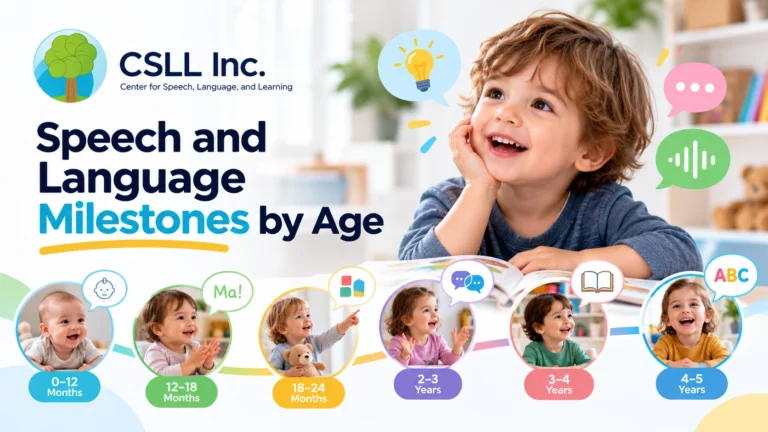
Not sure which one fits? Speech delay in toddlers and speech milestones by age explain what parents often notice first, including signs of a language delay.
Listen for examples of similar cases, without names, instead of general claims.
8. How do you coordinate with OT, AAC, or school teams?
Look for a clinic that shares findings with the other adults in your child’s day and can name how it does that.
Many children work on related skills with an occupational therapist (OT), a school team, or an AAC device. Ask whether the clinic will talk to teachers, send reports, and train the people who use the device.
At CSLL, speech-language pathologists, occupational therapists, and EIDBI specialists work under one roof. Our AAC services include hands-on training for your child, your family, and your child’s school team.
Listen for a process, such as reports, calls, or meetings, not “we are happy to talk if needed.”
9. Where are you, and when are appointments available?
Weekly therapy is a long commitment, so test the drive and the appointment times against your real week before you choose.
Map the trip at the time of day you would travel. Ask how cancellations and make-up visits work.
CSLL is at 434 Hayward Avenue N. in Oakdale (get directions), and we see families by appointment Monday through Friday. On your first call, say three things:
- Who would treat my child?
- When could an evaluation happen?
- When would weekly sessions open?
Listen for: schedule options that fit around school hours and a clear cancellation policy before you book.
Should You Visit More Than One Clinic Before Choosing?
Contacting two or three is reasonable, especially if your first call left you unsure. Use the same nine questions each time so the answers compare cleanly. A simple grid keeps the answers side by side:
| Check | Clinic A | Clinic B | Clinic C |
|---|---|---|---|
| Licensed SLP evaluates and plans | |||
| Measurable written goals | |||
| Defined parent role | |||
| Start date for weekly sessions |
For a wider list of certified providers, ASHA’s ProFind directory lets you search by location.
What Are the Red Flags When Choosing Speech Therapy for Kids?

Slow down if a clinic cannot tell you who will treat your child, what the goals are, or how you will know the therapy is working.
- Vague answers about who delivers sessions, or reluctance to share a license number
- No written plan, or goals such as “improve speech” with no way to measure them
- Pressure to commit to a long block of sessions before an evaluation
- Guarantees of a result or a fixed number of sessions
- The same activities for every child, whatever their age or concern
- No role for parents and no guidance to use at home
- No clear way of working with your child’s school or other providers
One red flag deserves a follow-up question. Several mean it is time to keep looking. This guide is general information, not a diagnosis or a promise of results, and your child’s evaluation sets the plan.
Seen one of these? Meet our team and ask us the same nine questions.
How Does CSLL Answer These Questions?
At Center for Speech, Language, and Learning, licensed speech-language pathologists in Oakdale work with children from toddlers to school age, and your child sees a consistent therapist.
- Who: licensed speech-language pathologists, alongside occupational therapists and an EIDBI-ABA team. Meet our team to see who you would work with.
- How we work: play-based sessions with games, stories and hands-on activities rather than drilling.
- One roof: speech therapy in Oakdale, occupational therapy and EIDBI, all in one clinic. See all services.
The Bottom Line: Choose the Clinic That Can Show You Its Answers
Knowing how to choose a pediatric speech therapist comes down to comparing every clinic on the same nine questions.
A licensed speech-language pathologist, measurable goals and a clear role for you matter more than any promise.
Write down each answer, listen for specifics, and slow down when the answers are vague.
Schedule, location and coverage decide whether therapy stays sustainable week after week.
When the answers are clear, you can book with confidence.
Ready to Choose a Pediatric Speech Therapist? Contact CSLL Today
If you have narrowed your search, you do not have to keep comparing alone. At Center for Speech, Language, and Learning (CSLL), our pediatric speech-language pathologists work with families in Oakdale and the east metro to understand your child’s communication and recommend the right next step. Call or email us to ask these nine questions and talk through what you have noticed.
📍 Location: 434 Hayward Ave N, Oakdale, MN 55128
📞 Contact Number: 651-739-2300
✉️ Mail: office@csllinc.com